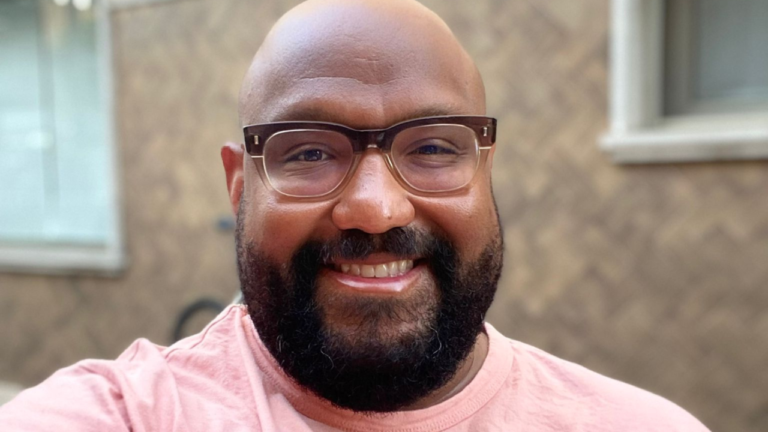
Sam Colson is autistic, ADHD, queer, and non-binary. They write from lived experience at the intersections of multiple marginalised identities.
For me, intersectionality is not a concept, it’s how I exist. That’s why I’m especially excited to support the first ever Intersectionality Awareness Week, which recognises and raises awareness of the unique barriers faced by people who have different intersecting identities. It’s a reminder that inclusion must mean all of us.
The intersectionality list
A couple of years ago, I started a list that I named “The things that make me different list.” Not the most creative title for a marketer, but it got the job done. It was a running list of all the things that set me apart from the people around me.
I began with things I’d come to understand through medical assessments: autism, ADHD, colour blindness. Then I added parts I’d uncovered through self-expression: my queerness, my gender identity.
At first, the list made me feel more grounded. I’d just graduated, and life had slowed down. Without the structure of university or the buzz of student leadership roles, I was left with long days, job applications, and a growing sense of doubt about my abilities, about being taken seriously, about who I was without the mask I’d spent years perfecting.
What began as an act of self-understanding quickly turned into something else: a tool I’d use again and again to explain myself just to be seen.
Invisibility is a full-time job
Being diagnosed with autism at 11 meant I learned to mask young. I got so good at it, I even hid ADHD traits from myself. By the time I was formally diagnosed at 24, things I’d dismissed started to make sense. But masking has a cost. I’m often read as “capable enough to work, not disabled enough for support.”
My queerness and non-binary identity don’t show up in the ways people expect either. With my autism, I go for comfort over style: hoodie, t-shirt, no fuss. Unless I speak up, I don’t “look” queer or non-binary. And maybe that’s the point, we shouldn’t have to look a certain way to be believed.
Different parts of me don’t just sit side by side, they shape and influence each other. Being white and assigned male at birth changed how my neurodivergence was received. It’s likely why I was diagnosed so young. Being non-binary shifts how my queerness is understood. Together, these intersections affect how I’m seen, or not seen, in every space I enter.
What ties all these identities together is a quiet kind of invisibility. Unless I tell you, you wouldn’t know they were part of me. But that doesn’t mean they don’t affect my life. It just means I have to keep explaining, performing my difference to prove it’s real – and that performance is exhausting.

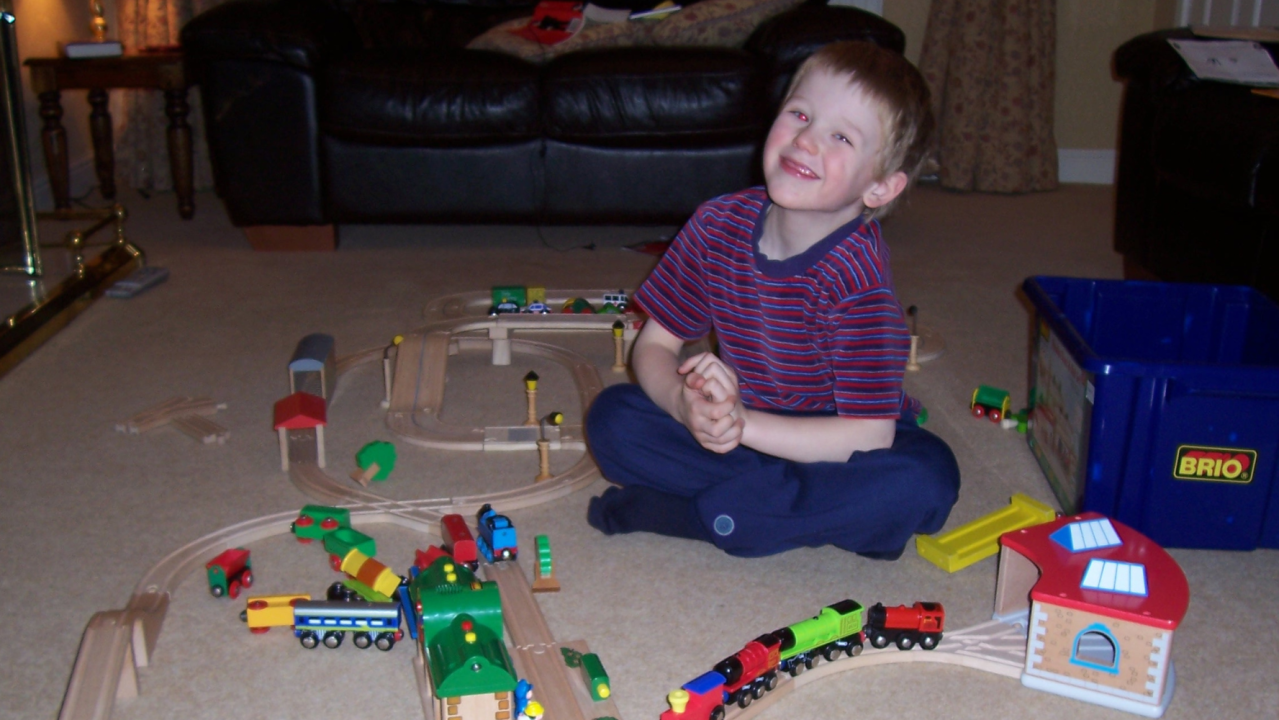
Me, age 5, completely absorbed in my train set. I didn’t have the words for it yet, but even then, I was building a world that made sense to me – structured, creative, and quiet enough to think in.
What people call political is often just personal
My parents used to joke that I liked to get on my soapbox. But often, my “politics” are just me trying to survive a world not built with me in mind. In our society, a society where your value is measured by your ability to make money, simply existing outside the mould is treated like a threat.
That mould is shaped by capitalism. And in capitalism, if you can’t work the same way, at the same pace, or in the same shape as everyone else, you’re seen as a problem, not a person in need of support.
Like it or not, this is the system we live in. While I believe it must change, surviving in it often means learning to navigate it on its own terms.
I can do the job. I do it well. In the right environment, one that understands how I work, I thrive. I exceed expectations. My neurodivergence helps me notice details others miss and bring creative solutions others don’t see. People are surprised by my dedication. I’m not.
The problem isn’t that disabled people can’t contribute. It’s that we’re expected to fit into narrow definitions of value that were never designed for us. If I’m forced to stay in that box, to work in ways that burn me out, that’s when problems arise. Not because I’m incapable, but because the structure is rigid.
And here’s the truth: not everyone can or should be expected to work. Our value isn’t just in what we produce. It’s in how we live, how we care, how we show up. A better world would honour that. But for now, we have to navigate the current world, while continuing to advocate for change that comes too slowly.
Inclusion isn’t inclusion if it punishes difference
Recently, I was made redundant. It wasn’t my fault, just a sign of the economic times. But even when you know it’s not personal, it still hits deep. Job hunting is hard. Job hunting with multiple invisible identities is a different game entirely.
Every application forces me to ask questions I shouldn’t have to. Will they see my potential, or just my difference? Will they accommodate how I work, or squeeze me into a shape that harms me? And will I be included, or merely tolerated?
I’ve seen what happens when I’m read as a white, gay, cis man who masks neurodivergence. I became the “safe” diversity hire, just edgy enough to tick a box, not disruptive enough to need change. But add in being openly non-binary, disabled, and vocal about access? Suddenly, the doors don’t open quite so easily.
That’s the thing about tokenism. It doesn’t value you. It values how marketable you are, how you can be used to further corporate goals.
Too often, organisations want diverse perspectives, but only if they don’t challenge how things are done. Organisation’s want innovation, but only in a familiar package. They want inclusion, but only if it doesn’t mean changing their systems, biases, or definition of professionalism.
But you don’t get the benefit of neurodivergent thinking without making room for neurodivergent ways of working. You don’t get the richness of queer identity by expecting it to fit your comfort zone. And you don’t get the strengths of disabled people if your systems are built to exclude us.
Choosing visibility this Intersectionality Awareness Week
I’m not interested in being included on someone else’s terms. If you hire me, you’ll get someone who thinks deeply, works hard, and cares fiercely about creating space where others can thrive. But you’ll also need to be ready to listen. To adapt. To make room. Not because I’m fragile, but because I’m different. And that difference is a strength, not a flaw.
I’ve stopped writing the list to explain myself to others. These days, it’s just for me.
My queerness and non-binary identity shape how I love, how I relate, how I think. My neurodivergence shapes how I notice, how I care, how I create. These aren’t things to hide. They’re things to build around.
What keeps me going is knowing I’m not alone. So many of us carry identities that don’t show up on the surface. So many of us have been told we’re too complicated, too political, too much, when really, we’re just trying to live honestly in a world that makes that hard.
Each time we share our stories, we make it a little easier for someone else to do the same.
Every time we name our needs, we challenge the systems that have ignored them.
And when we show up as ourselves, we stretch the limits of what’s possible.